
Campbell Detention Center Release Paths
Campbell County Adult Detention Center, or CCADC, is the county’s local adult-custody endpoint within the Blue Ridge Regional Jail Authority. BRRJA operates the facility. The Campbell County Sheriff’s Office may arrest a person or retain separate public-safety records, but it does not operate this jail. Release and closing booking records should therefore be directed first to the regional authority.
A local defendant may leave CCADC after posting bond, release on recognizance, dismissal, time served, completion of a local sentence, or another court order. Those events can lead back to the community. A person committed to the Virginia Department of Corrections may leave the Campbell facility for state custody instead. A warrant, detainer, or another agency’s authority can lead to another jail, the U.S. Marshals, or immigration custody. A name leaving the roster tells only that the current Campbell view no longer shows the person.
| Recorded path | What to check next |
|---|---|
| Bond, recognizance, or court order | Compare the BRRJA release entry with the latest Campbell court order and confirm physical processing. |
| Time served or local sentence completion | Use the jail’s closing booking entry for the custody end and the signed sentencing order for legal context. |
| Transfer within BRRJA | Check the destination facility’s authority-linked search and ask BRRJA for the recorded transfer destination. |
| Transfer to VADOC | Use the VADOC Inmate & Supervisee Locator, not a local released-person assumption. |
| Federal or immigration pickup | Follow the receiving agency named in the record through BOP, USMS, or ICE channels as appropriate. |
Note: A transfer ends CCADC custody but does not establish release to the community or final discharge from every sentence.
Confirm a Campbell Detention Center Release
The public Campbell JailTracker is the correct first online check for current local custody. BRRJA links to this facility-specific instance. It is not a public release archive, and no official 24-hour or 72-hour released-person view was verified. A current match supports that the person was shown in local custody at the last update. No match remains ambiguous.
- Gather the full name, aliases, approximate age or birth date, booking date, booking number, and court case number when known.
- Search Campbell JailTracker and record the exact spelling, booking details, reporting facility, charges, and bond information shown.
- Search Virginia Jail VINE for the same person, compare identifiers, and read the precise event and reporting agency.
- Review the Campbell General District or Circuit Court record for bond, disposition, sentence, appeal, or revocation activity.
- Add VADOC when a state commitment or supervision is possible, then add BOP, USMS, or ICE only when the case or destination supports it.
- Request BRRJA’s closing booking-and-release entry for the recorded time, release type, authority, and destination.
That chain separates legal authority from physical action. A court docket can explain why confinement should end, while the jail entry records how CCADC custody actually ended. VINE can flag a custody event, but it is not a certified discharge document. The full county search and records process is organized on the Campbell County released-inmate search page.
BRRJA’s Campbell Release Search Quirk
Campbell’s regional-authority structure creates an important search limit. BRRJA operates centers for several member jurisdictions and provides a separate JailTracker link for each facility. A person may move from the Campbell center to another BRRJA center, disappear from the Campbell instance, and still remain confined by the same regional authority.
Checking only the Campbell URL cannot prove community release. When VINE or a booking entry reports a transfer, follow the named destination. If the public result does not state it, ask BRRJA for the receiving agency or destination field in the existing closing record. This is also why a search on the Campbell Sheriff’s site is not a substitute: the Sheriff and BRRJA have distinct roles and distinct records.
Campbell Detention Center Release Record
A focused request should identify one booking and ask for existing fields. BRRJA’s public interface does not promise that a released booking remains searchable for any set period. The archival fallback is the authority’s booking-and-release entry, not a reconstructed answer based on screenshots from different days.
| Requested field | Why it matters |
|---|---|
| Booking number | Separates the relevant admission from older bookings or a same-name person. |
| Admission date and time | Marks the start of the jail episode being researched. |
| Release date and time | Records when BRRJA closed its custody for that booking, if maintained. |
| Release reason or type | May distinguish community release from transfer using the custodian’s own terminology. |
| Releasing authority | Can connect the event to a court order or another legal authority. |
| Destination or receiving agency | Shows where to continue the search when custody passed elsewhere. |
| Booking photograph | Identifies the image attached to that booking, subject to retention and disclosure rules. |
Charges listed in a jail record are not convictions. Reconcile them with the court disposition. If the record conflicts with a VINE event or receiving-agency result, compare the update times and ask the office that created the disputed entry to address it.
CCADC Records and Contact
The official facility page identifies CCADC at 90 Courthouse Lane, Rustburg, Virginia. BRRJA lists Captain J. Lambert as administrator. No official lobby hours, fixed release hour, release exit, family waiting point, public transportation plan, or property-pickup process was found. Call the facility for current operational instructions rather than assuming a routine.
Campbell County Adult Detention Center
Blue Ridge Regional Jail Authority
90 Courthouse Lane
Rustburg, VA 24588
Mail: P.O. Box 770
Rustburg, VA 24588
Phone: (434) 332-9583
Fax: (434) 332-5187
Note: Call before traveling because the published sources do not identify a release door, visitor waiting point, or property window.
Request CCADC Release Records
BRRJA’s FOIA officer is Patricia Stevens. Requests may be sent by email to foiarequest@brrja.state.va.us, by telephone at (434) 847-3100 ext. 1224, or by mail to BRRJA, 510 Ninth Street, Lynchburg, VA 24504. The authority’s FOIA page is the main jail-record route. No booking-photo-specific fee schedule was published, so ask for an estimate.
A request can seek the existing booking-and-release record for a full name and approximate booking date, including the booking number, admission and release times, recorded release type, releasing authority, receiving agency or destination, and associated booking photograph. State a preferred electronic format. If part of the record is withheld, ask for the legal basis and all segregable nonexempt portions.
The Campbell Sheriff/Public Safety request channel should be used for Sheriff-created arrest or public-safety records. It should not be assumed to hold BRRJA’s jail entry or booking image. Campbell County’s general fee policy also should not be presented as the regional authority’s pricing.
Virginia Rules for CCADC Records
Code of Virginia § 53.1-116 requires the jailer to keep a descriptive record of each committed person, the cause of commitment, terms of confinement, and receipt date, along with a written policy for earning and revoking credits. That duty supports requesting the existing admission, release, and computation record rather than trying to calculate a release from a sentence headline.
The official statute page shows the local-jail record framework: review the current Virginia code source.
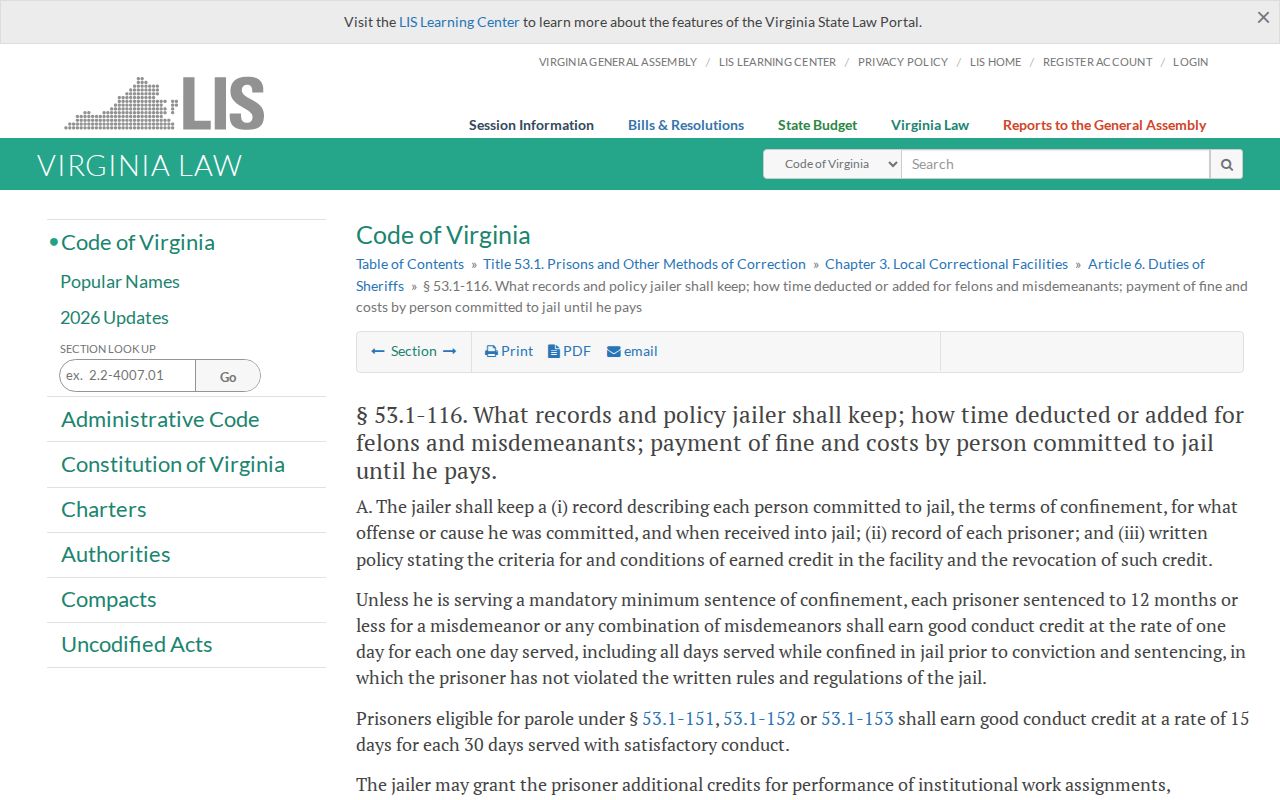
The statute supports a records-based inquiry, while the court order and the person’s actual credit history remain essential to any date calculation.
Virginia FOIA supplies request procedures and reasonable-cost rules. Section 2.2-3706 addresses law-enforcement and criminal records, including limits and protected material. Juvenile, sealed, expunged, medical, victim-identifying, security-sensitive, and active-investigation information may require withholding or redaction. Access to a public record does not mean every associated field or image is unrestricted.
VINE and Campbell Court Release Checks
Virginia Jail VINE receives events from local and regional jails. Search the correct person by name and available identifiers, then read the exact status and reporting agency. Virginia’s workflow materials warn that a local event can say released or transferred as responsibility shifts to VADOC. Registering for the jail record does not automatically register the person in the separate VADOC notification workflow.
Campbell General District Court commonly carries misdemeanors, preliminary felony proceedings, bond events, and lower-court dispositions. Circuit Court carries felony trials and sentences, district-court appeals, and later orders in its cases. An online disposition can outlast the jail roster entry, but it does not state when jail staff completed physical release. Obtain the signed order when the summary is unclear, then compare it with BRRJA’s custody-closing record.
Transfers from Campbell Detention Center
If the sentence suggests state commitment, search the VADOC Inmate & Supervisee Locator. A state-facility result means incarceration continues. A community-corrections district result can mean physical release under supervision. Neither should be reduced to a bare “released” label without stating the continuing status.
When a federal number or federal case exists, BOP is the sentenced-prison route and the federal docket or USMS inquiry is the pretrial route. If BRRJA records an immigration destination, use ICE’s Online Detainee Locator System. “Released to ICE” is a transfer from local to immigration custody. A no-result in any receiving system can reflect timing, scope, or identifier problems and should be followed with the agency named in the source record.
Note: Destination data is often the decisive field because it separates a community exit from continued custody under another authority.
About Campbell Adult Detention Center
CCADC is a regional jail facility and Campbell County’s primary adult detention site within BRRJA. It can hold a local pretrial defendant, a locally sentenced person, someone awaiting state transport, or a person subject to another agency’s hold. Those custody classes do not share one release path.
No official current annual release count, average length of stay, or release-reason breakdown was found. JailTracker may display identifying details, charges, bond information, and a booking photograph when the interface and record allow it, but BRRJA does not promise a post-release display period. For a historical release or image, request the booking-specific record from the authority.
Rustburg Correctional Unit is a separate state prison in the same county. Its prisoners belong in VADOC’s search and release process, not Campbell JailTracker. The Rustburg Correctional Unit release page explains that state route.