
Campbell Parole Versus Probation
Parole and probation both allow a person to live outside a jail or prison under stated rules, but they begin in different ways. Parole is conditional release from a prison term for someone who is legally eligible. The Virginia Parole Board decides whether to grant it, and Virginia Department of Corrections Community Corrections supervises the person. Probation is imposed by a court. It may follow jail or prison time, replace some active time through a suspended sentence, or begin without confinement. A Campbell County court order is the best source for the probation term. The VADOC locator and district office help confirm current state supervision.
| Status | How it begins | Best verification source |
|---|---|---|
| Parole | Conditional release from an eligible prison sentence after Board action | Virginia Parole Board result, then VADOC status or executed parole papers |
| Probation | Court-ordered supervision, often tied to suspended sentence time | Signed Campbell court order, VADOC locator, and District 13 |
| Final discharge | Custody and the relevant supervision term have ended | VADOC or court discharge record from the responsible agency |
A jail release is not the same as final discharge. Someone may leave Campbell County Adult Detention Center on probation, transfer into VADOC custody, or return to the community with no VADOC supervision. Likewise, a result locating a person at a community corrections district means that physical confinement has ended but legal supervision continues. Campbell JailTracker is a current local custody tool, not a probation or parole register.
Post-release supervision must also be separated from federal supervised release. VADOC District 13 handles Virginia probation and parole assignments in its service area. A federal court and the federal probation system control supervision imposed in a federal case. A prior Campbell jail stay does not convert a later federal status into Virginia parole or probation.
- Parole
- Conditional community release from a prison sentence for a person eligible under Virginia law.
- Probation
- Court-ordered community supervision, often linked to conditions and suspended sentence time.
- Discharge
- The formal end of the relevant custody or supervision obligation.
- Absconder
- An agency allegation that a supervised person has lost contact or failed to comply, not a new conviction.
Verify Campbell Post-Release Supervision
The VADOC Inmate and Supervisee Locator is the first public check for a person on state probation or parole. Its name is important. The locator covers people at correctional facilities and people assigned to community-supervision offices. VADOC says it is updated daily, yet it also warns that details may be inaccurate or out of date. A DOC ID is the strongest search key. Name search requires at least the first three letters of the first name and the full last name, with optional location, race, gender, and age filters.
- Collect the exact name, date of birth or age, court case number, and seven-digit DOC ID if known.
- Accept the locator disclaimer and search by DOC ID. If no ID is known, use the required name fields and add filters only to separate similar matches.
- Read the listed location. A correctional facility indicates custody; a district office or community program indicates supervision outside prison.
- Use the Community Corrections directory to identify the responsible office. Campbell County is served by District 13 in Lynchburg.
- Compare the result with the latest signed Campbell court order or parole papers. Ask the responsible office only for facts it may lawfully confirm.
No match proves very little on its own. The name may differ, the record may lag, supervision may be local rather than VADOC-run, or the person may have completed supervision. For a prior Campbell jail stay, the full custody and release path is explained on the Campbell County released-inmate search. It separates a current jail booking, a transfer, state supervision, and final discharge.
VADOC’s official locator screen shows why name and DOC ID are separate routes. Review the state locator at its source before relying on a saved result.
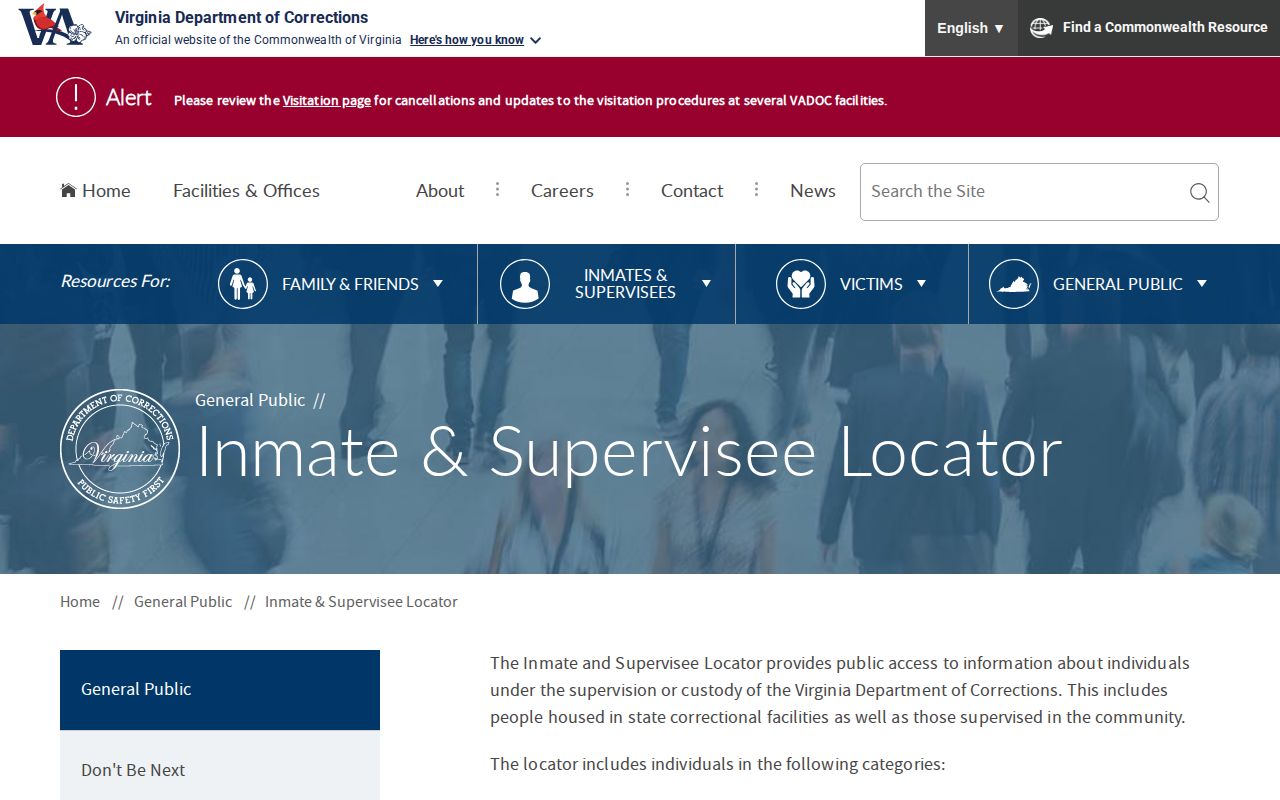
The captured state page is a starting point, not proof that a past status remains current. Record the date checked and verify the reporting location.
Campbell Supervision at District 13
VADOC District 13 in Lynchburg serves Campbell County, Amherst County, Nelson County, and the City of Lynchburg. The current state directory is the controlling contact source. An older Campbell Judicial Services page shows another Lynchburg street address with the same telephone number, so it should not be blended with the current listing. Confirm the office against the VADOC directory before sending mail or traveling. Research did not establish public walk-in hours.
VADOC District 13, Lynchburg2209 Florida Avenue
Lynchburg, VA 24501
(434) 947-6651
Serves Campbell, Amherst, Nelson, and Lynchburg
District 13 is the useful local contact after a locator result points to community supervision. It is not the custodian of a BRRJA jail release entry and does not replace the Campbell court clerk for a signed probation order. These roles should stay distinct. A court states what supervision was ordered. VADOC reports and manages the state supervision assignment.
Note: The VADOC directory should be checked again before an office visit because agency addresses and staff assignments can change.
Campbell Parole Decision Records
The Virginia Parole Board, not Campbell County or BRRJA, decides parole for eligible Virginia cases. Its public meetings page carries event-based notices, agendas, webcast information, and archived minutes. The calendar does not promise a weekly or monthly hearing for each named person. Since July 2024, final deliberation and voting on parole grants take place in a public meeting under the governing rules, but a posted meeting still should not be read as a scheduled prison exit.
The Board’s monthly parole reports are the better results source. A representative report includes DOC number, name, case type, decision and certification dates, jurisdiction, offenses, sentence information, reasons or conditions, and Board-member votes. Terms such as grant, non-grant, defer, and rescind have distinct meanings. A grant remains subject to certification and release processing. VADOC supervision status or the executed release document provides the second check that a person actually left confinement.
The official report archive illustrates the difference between Board action and release status. Open the Virginia Parole Board reports source to select the relevant month.
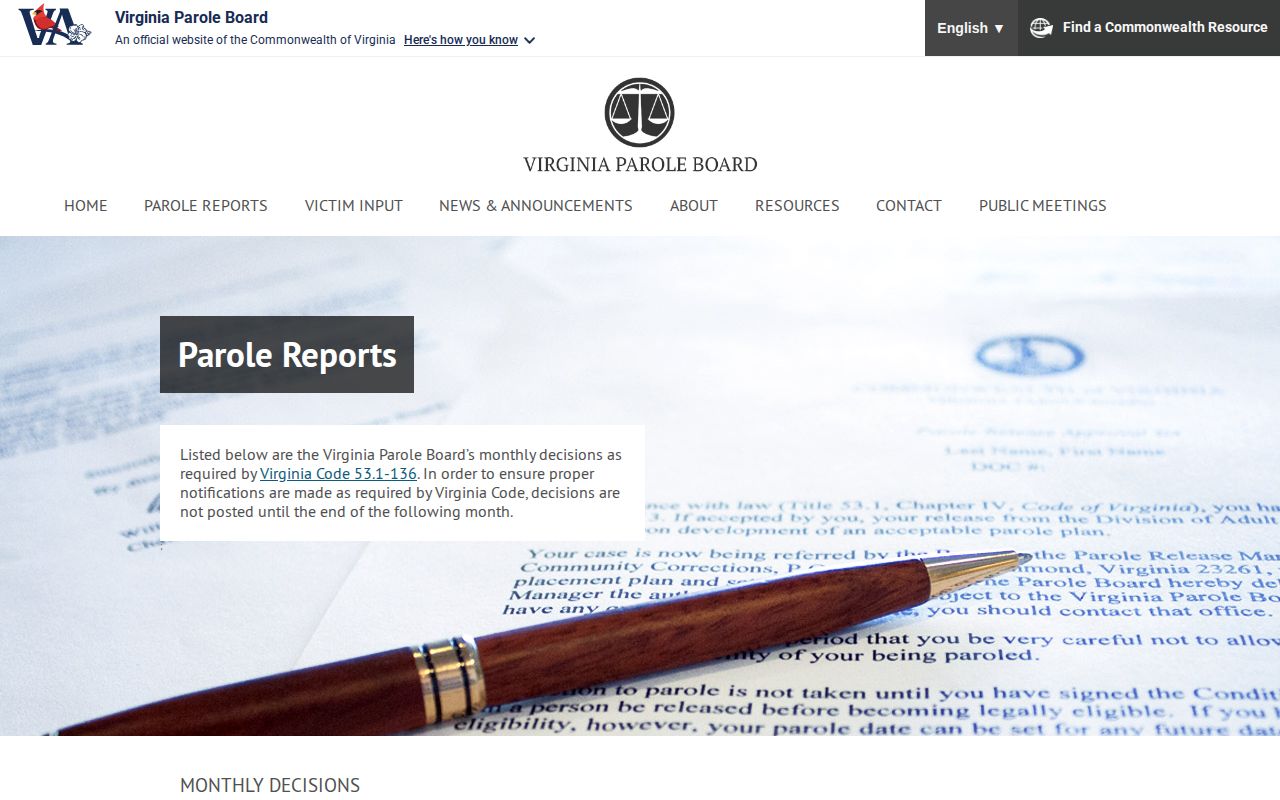
The archive image points to published decision records, while later VADOC records establish custody or community-supervision status.
Campbell Parole Eligibility Limits
Virginia parole eligibility depends on the offense date, the sentence, prior commitments, and statutory exceptions. Virginia Code § 53.1-165.1 generally abolished parole for felony offenses committed on or after January 1, 1995, except where another law provides eligibility. Older-law and special cases remain possible. Section 53.1-151 contains rules for first and later commitments and for special categories.
A sentence headline is not enough to calculate eligibility. Consecutive terms, the controlling subsection, offense date, exclusions, and earlier commitments can alter the result. Parole eligibility is also not the same as a projected release date. Eligibility marks when review may be possible. It does not promise a grant or a release date. The signed sentencing record and the agencies responsible for computation and review control.
Note: A monthly Board report verifies the stated decision, but VADOC status must confirm whether confinement later ended.
Campbell Supervision Status Warnings
Conditions of probation or parole are found in the governing court order or signed release papers. If the supervising agency uses the word “absconder,” it alleges lost contact or noncompliance. It is not a new conviction. Campbell County has no verified public county-specific probation or parole absconder list. VADOC’s statewide Most Wanted material is not a substitute for checking a specific warrant with the issuing court or law-enforcement agency.
Virginia Jail VINE alerts serve a different role. They report local or regional jail custody events, while VADOC notification programs concern state custody. A person returned to Campbell County Adult Detention Center on a violation may appear in JailTracker, but that booking does not by itself prove that supervision was revoked. The court docket and later signed order show the legal result. A VINE alert can flag a change, not decide the case.
Campbell Release Programs Through BRRJA
BRRJA’s authority-wide programs page lists Pre-Release, Progressive Release, Re-Entry, DMV Connect, home electronic monitoring, Weekender, Work Release, Work Force, education, life-skills, religious, and substance-use programs. This is a distinctive regional layer for Campbell County because BRRJA, rather than the Sheriff, operates the adult detention center.
The authority-wide list does not promise that each program operates at Campbell County Adult Detention Center or that a named person qualifies. No Campbell intake schedule was published in the source. Ask BRRJA about current local availability and the program’s legal effect. Participation may prepare someone for release or shape how a sentence is served, but it is not proof of parole, probation, or final discharge.
Campbell Supervision and Final Discharge
Supervision ends through the process stated in the governing order and agency record. A person can finish probation, receive a parole discharge, or have the status changed by a later court or Board action. The cleanest proof is the official discharge record from the responsible body. A missing locator result is weaker because it may reflect spelling, delay, record scope, or a nonpublic circumstance.
Keep three dates separate: the day physical custody ended, the day community supervision began, and the day supervision ended. Campbell County Adult Detention Center or BRRJA documents the local custody event. VADOC documents its prison or supervision stage. The court or Parole Board supplies the legal authority. Matching those layers prevents a released person from being described as fully discharged when obligations remain.