
Campbell Projected Versus Actual Release
A projected release date is the responsible agency’s current calculation of when a sentence may end or a qualifying release may occur. It is not the same as the moment a person walks out. Actual release follows records checks, any transfer or detainer review, and final processing. VADOC uses “projected release date” in its operating procedure, while Victim Services calls an advance date “anticipated.” Both terms signal that the date can change.
Pretrial custody works differently. A person held at Campbell County Adult Detention Center before disposition may leave after bond, recognizance, dismissal, or a court order, but there is no sentence-based end date to calculate. Even an order authorizing release may not lead to community release if another case, warrant, appeal, or detainer applies. A sentenced person has an active term, yet the displayed date still depends on credit and current legal inputs.
Transfer is another source of confusion. Leaving the Campbell jail for VADOC, another jail, federal custody, or immigration custody ends one custodian’s event but not confinement. A projected date must be read with the listed agency and destination.
The record layer changes with the question. A Campbell court docket can show the sentence, bond action, or amendment that supplies legal authority. BRRJA’s jail entry can show when its physical custody ended. VADOC’s computation and release papers cover a state-responsible sentence. VINELink may announce an event, yet it does not replace those records. When dates conflict, compare update times and ask the originating custodian to explain or correct its own record.
Find Campbell Projected Release Dates
Start with the custody system, not a broad name search. The VADOC Inmate and Supervisee Locator is appropriate for a state prisoner, someone held under VADOC authority, or a person later placed under VADOC supervision. Campbell JailTracker is for current local custody. It is not a release-date archive. BRRJA records and the Campbell court file are the sound local sources when a person is serving a county sentence.
- Identify whether the person is pretrial, serving a local sentence, committed to VADOC, or in another sovereign’s custody.
- For VADOC, search by the seven-digit DOC ID when possible. A name search needs the first three letters of the first name and the full last name.
- Read the location and the public release-date field together. A community district indicates supervision, while a correctional facility indicates custody.
- For a Campbell local sentence, obtain the signed court order and ask BRRJA for the existing admission, credit, computation, and release record.
- Check for later court orders, detainers, transfers, or credit changes. Record the date and source of each answer.
VADOC says its locator is updated daily but may be inaccurate or out of date. A public result is useful for a current estimate. The court order and official time-computation or release record carry more weight if the date is disputed. The Campbell County release search supplies the broader path when the current custodian is unclear.
A fully discharged former state prisoner may no longer have the same public detail shown before release. Ask VADOC for the existing discharge or release record when that occurs. For a Campbell local sentence, request the booking-and-release entry and computation fields from BRRJA. A court disposition explains why custody should end, while the custodial record shows how and when the agency processed that end.
The official locator capture shows its name and DOC-ID routes. Visit the VADOC search source for the live record.
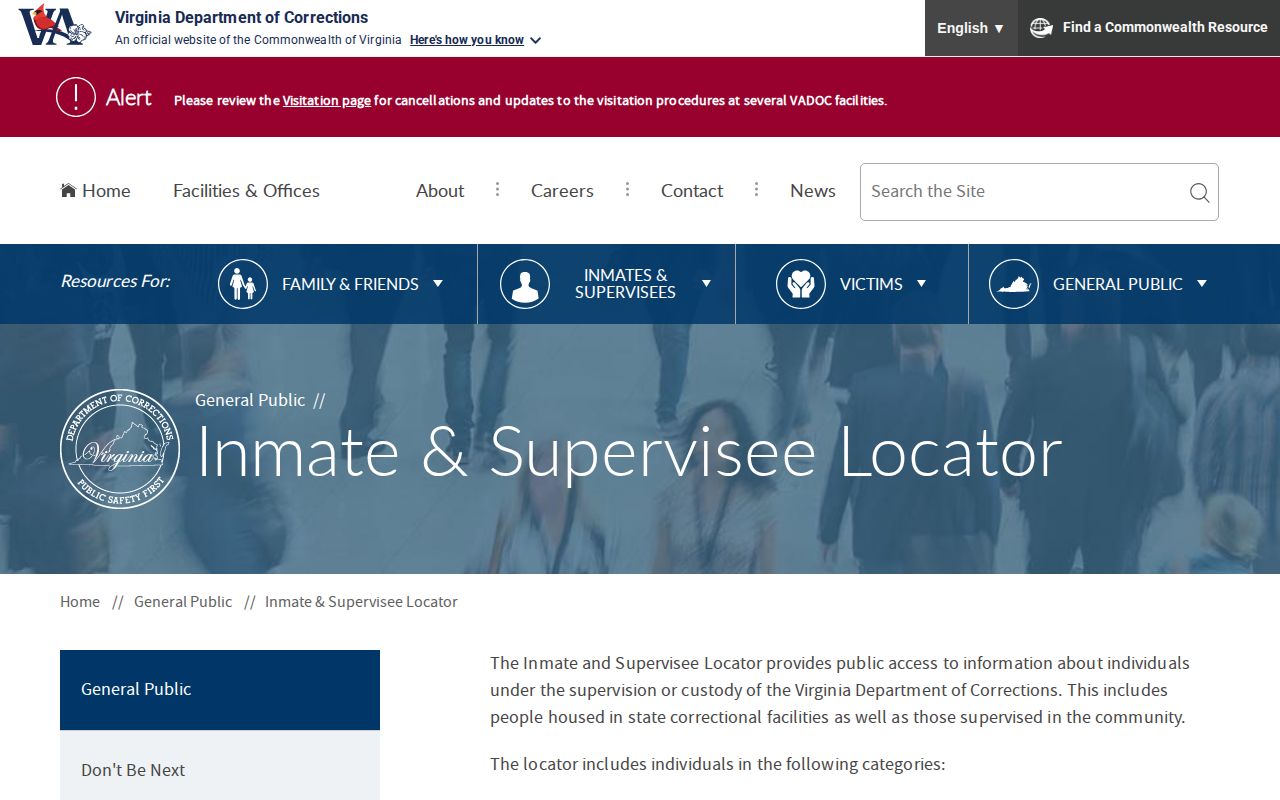
The search screen helps select the right person, but only the current result and originating record can establish the date reported today.
Campbell Local Release Computation
BRRJA and local officials compute confinement under the sentencing order and Virginia law. Virginia Code § 53.1-116 requires the jailer to keep a descriptive record of each committed person, including the cause, terms of confinement, and receipt date. It also requires a written policy on earning and revoking credits. That record duty supports asking BRRJA for an existing computation record rather than trying to derive a firm date from the sentence headline.
For an eligible person serving twelve months or less for a misdemeanor or combination of misdemeanors, the statute provides one day of good-conduct credit for each day served when jail rules are followed and no mandatory-minimum bar controls. A jailer may award up to five more days per thirty days for qualifying work, classes, or local workforce programs when available. A violation can add deducted time back. Post-1995 felonies served locally remain subject to the earned-credit limits that apply to that sentence.
Credit for time confined before trial is a separate input under § 53.1-187. That credit can make a newly entered sentence end sooner than someone expects, or result in time served. The signed order, eligible credit, and BRRJA record must be reconciled.
The local-jail credit statute is available in an official page capture. Read the current code text before applying any rule.
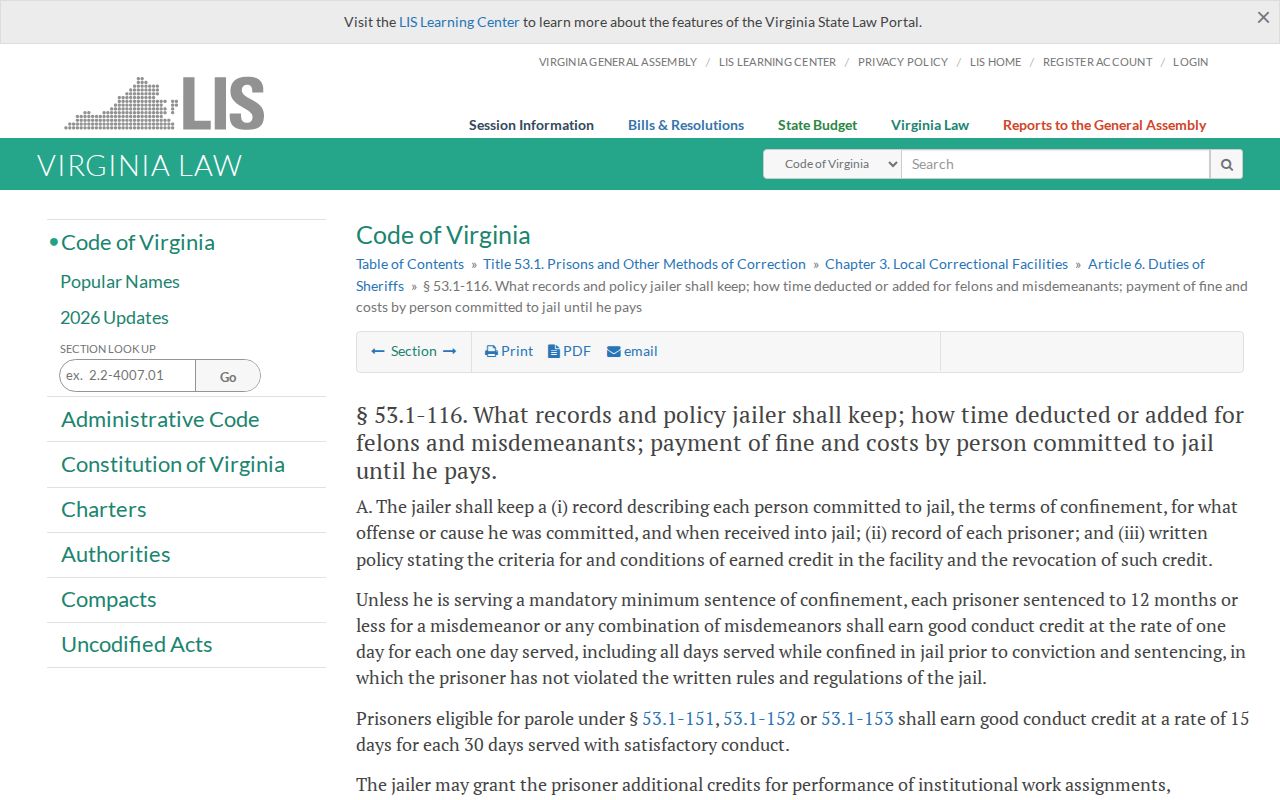
The statute explains the jailer’s record and policy duties; it does not publish an individual Campbell County projected release date.
Virginia Credits and Campbell Dates
Virginia’s truth-in-sentencing framework applies earned sentence credits to covered felonies committed on or after January 1, 1995. Section 53.1-202.2 defines one earned sentence credit as one day deducted from the term. Section 53.1-202.3 sets rates and exclusions.
For offenses listed in subsection A, the maximum is 4.5 credits for each thirty days served. That maximum produces the familiar statement that a person serves about eighty-five percent of the sentence. It is not a universal release promise. Other eligible offenses may use a four-level system. At Level I, fifteen days are deducted for each thirty days served, while lower classifications earn less. Classification reflects rule compliance and participation or cooperation with assigned programs, and it can change.
Older or otherwise governed sentences may use good-conduct allowance law. Parole eligibility is separate, and earned credits do not shorten the wait before parole eligibility under § 53.1-202.3. An offense name alone cannot establish the proper rate. Effective dates, statutory exclusions, and the controlling sentence all matter.
VADOC Computes Campbell State Dates
VADOC performs the official computation for a state-responsible person with an active post-1995 earned-sentence-credit term over twelve months. Its calculation begins with the court’s active term and considers prior jail time, sentence type, total imposed time, concurrent or consecutive terms, credit classification, disciplinary events, later court action, and other case changes. The public cannot reproduce that record with simple subtraction.
The VADOC time-computation explanation describes these moving parts. It also reinforces that state and local officials handle different sentence types. A person at Rustburg Correctional Unit follows the state process, while a short local sentence at Campbell County Adult Detention Center follows the BRRJA and court record path.
The state’s explanation can be reviewed in the matching official capture.
The source shows the agency framework behind a projected date and why official staff, rather than outside arithmetic, must confirm it.
Note: VADOC’s date is the current official computation, but a later valid input can still move it.
Why Campbell Release Dates Change
A projected date is only as current as its inputs. The change may affect the sentence calculation, the release plan, or the place where the person goes next. Some factors move the date itself. Others allow the original custodian to release the person on schedule but prevent release to the community.
| Factor | Possible effect | Best source |
|---|---|---|
| Earned-credit classification | A higher or lower lawful rate changes accrued credit | VADOC or BRRJA computation record |
| Discipline | Credit may be forfeited or later restored under governing rules | Custodian’s credit record |
| Prior confinement credit | Qualified jail time reduces active time remaining | Court order and computation record |
| Later court order | An amended, vacated, consecutive, or concurrent term changes the legal input | Signed court order |
| Detainer or warrant | The person may transfer to another custodian instead of entering the community | Release record and receiving agency |
| Parole action | A grant, denial, deferment, or rescission changes the parole path, not necessarily the sentence end | Parole Board and VADOC |
Always preserve the difference between a date change and a destination change. A release record stating transfer to VADOC, another jail, federal authorities, or ICE means local custody ended. It does not mean the person became free.
Campbell Release Calendar Rules
Virginia Code § 53.1-28 creates a real calendar rule. Subject to its terms, when a final discharge date falls on a Saturday, Sunday, or legal holiday, release is generally set for the preceding weekday, with statutory exceptions. The rule must be matched to the person’s custody class. It should not be applied to every bond, court-ordered release, or transfer.
Virginia also permits court-ordered weekend or nonconsecutive service in certain cases under § 53.1-131.1. The active remainder, eligible offense type, and Commonwealth-objection rules govern. Someone can physically leave after a weekend segment while the sentence remains unfinished. That event is not final discharge and should not be labeled that way.
Confirm Campbell Release Dates
Confirm a state date with the live VADOC locator and the agency’s computation or release record. Confirm a local date with the Campbell court order and BRRJA’s existing credit and release entries. If another hold appears, search the receiving custodian rather than assuming community release. Federal cases belong in BOP or the federal court and Marshals path, not VADOC.
A Virginia VINELink release check can provide an event alert for a specific record. It is not a certified discharge record and cannot calculate the date. VADOC Victim Services may issue an anticipated-release notice and update it if the date changes. At actual state release, the applicable Order of Release, Conditions of Probation, or Conditions of Parole is signed and witnessed. Those documents identify the legal status after custody.
VADOC states that discharge or parole release from a state facility occurs by the end of the release date, weather permitting. That state rule must not be assigned to Campbell County Adult Detention Center. Research found no fixed CCADC release hour, exit door, or weekend practice. For a local release, call the facility with the person’s exact identifiers and rely on BRRJA’s completed record after processing.
Note: Record the system, reporting agency, and check date whenever sharing a projected release date because each can change.