
Understanding Campbell County Inmate Release
Campbell County does not operate a separate sheriff-run adult jail. The Campbell County Adult Detention Center is part of the Blue Ridge Regional Jail Authority, or BRRJA. That distinction controls where the records live. The Sheriff’s Office may hold arrest and public-safety records, but BRRJA is the likely custodian of the jail booking, custody, and release entry. A person who leaves that center may be free in the community, yet the same roster change can also mark a move to another BRRJA center, VADOC, another jail, federal authorities, or immigration custody.
A useful release inquiry separates three layers. The court order states the legal basis for bond, dismissal, time served, sentencing, or another action. The jail record states how and when BRRJA custody ended. A later VADOC, VINE, BOP, or ICE record may show what followed. None of those sources should be made to answer a question outside its scope. In particular, a charge on a booking record is an accusation, while the court disposition records what happened to that charge.
Campbell County Release Paths
The closing custody entry may use a release reason or disposition tied to the event. The exact labels in BRRJA’s system are not publicly documented, so a requester should ask for the recorded value instead of presuming a term. These common paths explain which source should be checked next.
| Path | Meaning and next check |
|---|---|
| Bond or recognizance | The immediate detention ends under court conditions. Check the Campbell court docket and BRRJA release entry. |
| Dismissal or court order | The visible charge may no longer support custody, but another case, warrant, appeal, or hold may still control. |
| Time served or local sentence completion | BRRJA records the physical custody end. The signed court order explains the sentence and credited time. |
| VADOC commitment or transfer | Local custody ends while state custody continues. Search the VADOC Inmate & Supervisee Locator. |
| Other agency pickup | Another jail, the U.S. Marshals, BOP, or ICE may become the custodian. Follow the recorded destination. |
| Parole or probation | The person may live in the community while remaining under VADOC supervision through a district office. |
Note: The words “released” and “discharged” should not be treated as synonyms when supervision, a detainer, or another sentence remains.
Campbell County Bond-Out Releases
Campbell County’s Judicial Services information says magistrates may admit an adult to bail or commit that person to jail, and magistrate service is available around the clock. A bond-out ends the immediate detention subject to the terms set in the case. It does not dismiss the charge, erase the booking, or establish final discharge from every form of control.
No official CCADC bond schedule was identified in the research. The sound path is to read the magistrate or court record, confirm that jail processing is complete, and avoid relying on commercial claims about payment or timing. Even after a bond order, another warrant or detainer may prevent a return to the community. The court record explains the authority; BRRJA confirms the actual end of its physical custody.
Note: Magistrate availability around the clock does not establish a fixed CCADC release time or guarantee that processing is complete.
Fields in a Campbell County Release Record
There is no single universal document called a release record. For a Campbell County jail event, the most direct target is the existing booking-and-release entry tied to a named person, booking date, or booking number. A focused request can identify the precise fields needed and avoid asking staff to create a new explanation.
| Field | What it shows |
|---|---|
| Booking number | Connects the request to one admission rather than every record for a shared name. |
| Booked date and time | Marks when that jail episode began in the management record. |
| Released date and time | Marks when the named custodian closed the booking, if that field exists. |
| Release type or reason | May distinguish bond, court order, sentence completion, or transfer using the custodian’s own label. |
| Releasing authority | Identifies the court or agency connected with the custody-ending action when recorded. |
| Destination or receiving agency | Can distinguish community release from a handoff to VADOC or another custodian. |
| Bond and charges | Ties the event to the booking, but does not turn an accusation into a conviction. |
| Booking photograph | Identifies the image associated with that admission, subject to retention, disclosure, and redaction rules. |
The court docket and any signed order should be reconciled with this jail entry. VINE is useful as a custody-event alert, but it is not a certified discharge record. When two sources differ, compare their update times and ask the office that created the disputed record to clarify or correct its own entry.
Request Campbell County Release Records
BRRJA is the first request destination for its jail-management record. Its FOIA officer is Patricia Stevens at foiarequest@brrja.state.va.us, (434) 847-3100 ext. 1224, or BRRJA, 510 Ninth Street, Lynchburg, VA 24504. Use the BRRJA FOIA channel for the release entry or booking image. Use Campbell County’s Sheriff/Public Safety form only for material created or retained by the Sheriff’s Office.
- Identify the person with full name, aliases, approximate booking date, and a booking or court case number when known.
- Ask for the existing booking-and-release record and list the date, time, reason, releasing authority, and destination fields sought.
- State the preferred electronic format and request an advance estimate if the charge will exceed a limit you choose.
- If any part is withheld, ask for the statutory basis and the segregable nonexempt portions.
- If BRRJA is not the custodian, ask it to identify the known custodian and redirect the request.
Virginia FOIA permits reasonable charges based on actual cost. Under Code § 2.2-3704, a public body generally responds within five working days by producing, withholding with a basis, producing in part, reporting that records could not be found or do not exist, or invoking the allowed additional time. Campbell County publishes its own fee policy, but those county rates must not be represented as BRRJA’s schedule. Ask BRRJA for its estimate.
Note: A narrow request for existing fields is easier to route and price than a broad demand for every file about one person.
Virginia Law on Campbell Release Records
Virginia FOIA supplies the procedure, while Code § 2.2-3706 addresses law-enforcement and criminal records. Public access does not mean that every field, image, or investigative file must be disclosed. Juvenile information, victim-identifying details, medical material, active-investigation material, security-sensitive information, and sealed or expunged records may be restricted. A custodian can also redact protected parts while producing segregable portions.
No official public retention period was found for a released booking on Campbell JailTracker. A missing public result may reflect roster design, sealing, expungement, transfer, spelling, or update timing. It should not be described as deletion or proof that no booking occurred. Virginia’s current sealing framework can bar public access to covered electronic records, and the expungement law has versions with different effective dates. The controlling law and official judiciary guidance must be checked for the specific case.
Note: Public-record access and unrestricted reuse are different questions, so requesters should follow the custodian’s terms and applicable law.
Campbell Jail Turnover in Context
The 2020 PREA audit for the Campbell County Adult Detention Center offers rare local scale data. It reported 1,403 male admissions and 400 female admissions during calendar year 2019, or 1,803 admission events. The same audit reported an average daily population of 120 men and one woman.
Those figures describe historical admissions and population, not releases. They cannot support a daily-release estimate, a current population claim, or a statement about why people left. No official current annual release total, average length of stay, or release-reason breakdown was located for CCADC.
Search for Campbell County Released Inmates
The most reliable lookup begins with a custody class and a firm identifier. Record the full name, aliases, approximate age or date of birth, booking date, case number, and any DOC, A-number, or federal register number already known. Then work from the last known custodian toward the possible destination.
- Check the Campbell JailTracker. A match supports current local custody at the system’s last update.
- Search Virginia Jail VINE for the same person and read the exact status and reporting agency.
- Review Campbell General District and Circuit Court information for bond, disposition, sentence, appeal, or revocation activity.
- Search VADOC if a state commitment, state placement, or community supervision is possible.
- Use BOP, USMS, or ICE channels only when a federal case, number, detainer, or destination makes them relevant.
- Request BRRJA’s closing release or transfer entry when a document is needed or the online sources do not settle the issue.
Campbell’s Regional Jail Release Search
The regional-authority structure is the defining Campbell County search issue. BRRJA operates separate facilities and presents a distinct JailTracker link for each one. A person can leave the Campbell instance because BRRJA moved that person to another authority facility. The same regional agency may remain involved even though the Campbell search no longer returns the name.
For that reason, the Campbell instance is evidence about one facility’s current view, not proof of system-wide release. Search the exact reporting agency in VINE, ask BRRJA for the destination field, and use the receiving facility or agency system. The Campbell Sheriff’s page is also not a substitute for the BRRJA custody search because the Sheriff does not operate CCADC.
VADOC Search for Campbell Releases
The VADOC Inmate & Supervisee Locator applies when a person entered state authority, remains in a state institution, is housed locally under VADOC authority, or is under state probation or parole supervision. It is not a complete archive of short Campbell jail stays. VADOC says the data is updated daily and may still be inaccurate or out of date.
| Search route | Required and optional fields | How to read it |
|---|---|---|
| Name | First three letters of first name and full last name | Compare age, location, and other identifiers before selecting a result. |
| DOC ID | Seven-digit VADOC number | The stronger route when the official identifier is known. |
| Optional filters | Location, race, gender, and age range | Use only as needed to narrow similar names. |
| Result context | Custody, facility, supervision location, and public release-date information | A district office points to community supervision, while a prison location means confinement continues. |
The official locator screen shows the name and DOC-ID routes described above: open the VADOC source before searching.
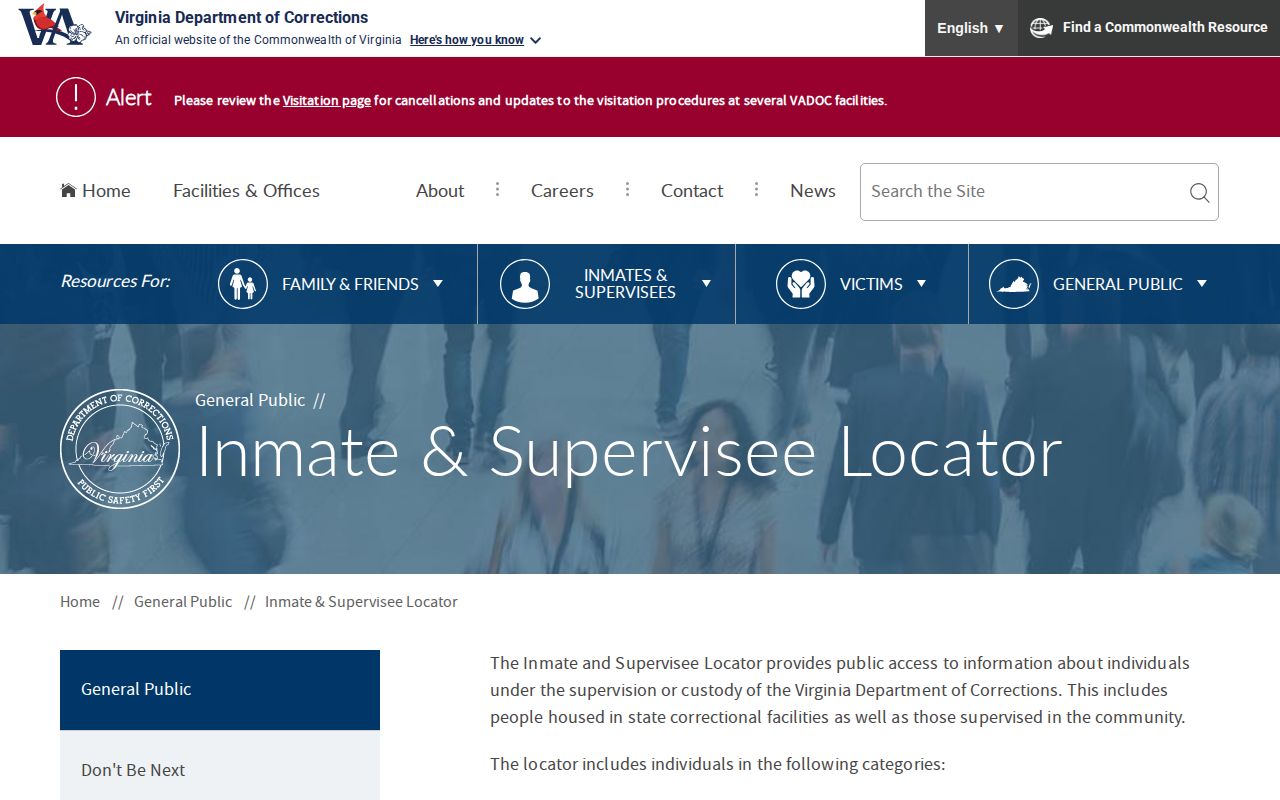
The displayed release date is VADOC’s current computation, not a fixed promise. Court changes, sentence credits, detainers, and processing can move it.
Note: A VADOC district-office result supports physical release to supervision, while a correctional-facility result shows that confinement still continues.
Campbell County Recent Release Records
No official Campbell or BRRJA rolling 24-hour or 72-hour released-inmate feed was verified. The Campbell JailTracker page is a current-custody lookup. Its cadence and post-release visibility period are not published, and it should not be converted into a release list by comparing names from one day to the next.
For a bounded time window, ask BRRJA for an existing release log or booking-release export with exact start and end timestamps. Useful fields include name, booking number, booking and release times, recorded release reason, releasing authority, and receiving agency or destination. Virginia Jail VINE can confirm events for a known person, while court dockets can confirm orders for known cases. Neither source recreates a jail-issued list of everyone released in a period. No official BRRJA mobile app advertising Campbell releases or booking photos was found.
Campbell Court Records and Release
Campbell County’s court trail is divided by court level. General District Court commonly carries misdemeanors, traffic cases, preliminary felony proceedings, and near-term bond events. Circuit Court carries felony disposition and sentencing, appeals from district court, and later orders filed in those cases. The statewide Online Case Information System can be searched by locality, court, name, case number, hearing date, and the filters offered by the selected system.
Read the online docket as a legal chronology, not a release timestamp. A dismissal, time-served sentence, or bond order may explain why custody should end, but jail staff still complete physical processing and must account for another warrant or hold. If the summary is unclear, obtain the signed order from the clerk and reconcile it with BRRJA’s release entry.
The statewide search interface helps locate the proper Campbell case: review the Virginia Online Case Information System source.
The court result can preserve disposition and sentencing context after a name is no longer visible on the current jail roster.
Note: The signed order is the stronger source when an online case summary leaves the sentence or release authority unclear.
Campbell Release Alerts and Supervision
Virginia separates local-jail VINE from the VADOC workflow. For a person held at CCADC, search Virginia Jail VINE and register against the correct person’s record if an alert is needed. A notice that says released or transferred means the reporting jail closed its custody event. It does not by itself show that the person entered the community. Registration does not automatically carry into VADOC’s separate notification process.
After physical release, VADOC’s locator can show probationers and parolees assigned to district offices. District 13 in Lynchburg serves Campbell County, Lynchburg, Amherst, and Nelson. A community-supervision location is evidence that incarceration ended while legal supervision continues. A no-result can reflect discharge, spelling, delayed data, local rather than VADOC supervision, or a nonpublic circumstance. It is not enough to infer that all supervision ended.
BRRJA Pre-Release Programs in Campbell
BRRJA’s authority-wide program page lists Pre-Release, Progressive Release, Re-Entry, DMV Connect, Home Electronic Monitoring, Weekender, Work Release, Work Force, education, life-skills, religious, and substance-use programs. Those listings help explain that a person may move through a staged status before or after leaving a secure custody unit.
The authority page does not promise that every program operates at CCADC, and it does not publish a Campbell intake schedule for each service. Program availability and a named person’s participation should be confirmed with BRRJA. A weekender can also leave the facility after one segment without completing the sentence, which is another reason physical exit and final discharge are not the same event.
Federal and ICE Release Checks
Use a federal channel only when the case, number, or destination supports it. The BOP Inmate Locator can show a historical release date and “Not in BOP custody” for a former sentenced federal prisoner. That wording means BOP confinement ended. It does not rule out federal supervised release, state or local custody, or immigration custody. For federal pretrial custody, the court docket and U.S. Marshals prisoner-information route are more apt because no public USMS released-prisoner name search was verified.
The ICE Online Detainee Locator System covers current detainees and people released from ICE custody within its stated recent period. Search by A-number and country of birth when possible, or use the requested biographical fields. A CCADC entry saying “released to ICE” describes a transfer. A no-result in ODLS does not prove community release, especially after a recent move or outside the system’s limited historical window.
Where Campbell Release Status Appears
The same name can appear differently across systems because each source tracks a distinct authority. Match the source to the last known custody and the question being asked.
| System | Still in custody | After custody ends there |
|---|---|---|
| Campbell JailTracker | A current match supports local detention at the last update. | No match is ambiguous; use VINE, courts, the receiving system, and BRRJA’s closing record. |
| BRRJA release record | The booking remains open in the jail-management record. | The closing entry may provide release time, reason, authority, and destination if recorded. |
| VADOC locator | A correctional-facility location supports state confinement. | A district-office result may show community supervision; a VADOC record supplies stronger discharge proof. |
| Virginia courts | The docket may show an order or pending case but not live physical custody. | Disposition and sentencing information may remain after the jail roster entry ends. |
| BOP locator | A federal facility result supports BOP custody. | A past date and “Not in BOP custody” show only that BOP confinement ended. |
| ICE ODLS | A locatable current result identifies immigration detention. | A no-result is not a complete historical release record. |
Campbell County Release Facilities
Two facilities in Campbell County require different search paths. The local center belongs to the regional jail system, while Rustburg Correctional Unit belongs to VADOC. Their records should not be mixed.
Campbell County Adult Detention Center
BRRJA operates this regional jail at 90 Courthouse Lane in Rustburg. A person may return to the community or transfer to VADOC, another jail, federal custody, or immigration custody. Confirm the recorded destination.
Rustburg Correctional Unit
VADOC operates this Level 1 state unit for men at 479 Camp Nine Road in Rustburg. Use the VADOC locator and release documents, since Campbell JailTracker does not cover state-prison status.